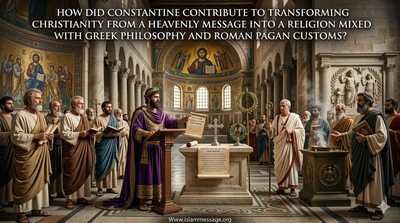
How did Constantine contribute to transforming Christianity from a heavenly message into a religion mixed with Greek philosophy and Roman pagan customs ?
After 1,700 years of the Council of Nicaea... Is what we know today truly what Christ taught ?
Seventeen centuries ago, in the year 325 AD, the Council of Nicaea was convened at the invitation of the Roman Emperor Constantine, an event that is still considered one of the most influential in the history of Christianity.
In that council, not merely passing religious disputes were settled, but rather the foundations of doctrinal beliefs were laid, which later became the standard of faith for most Christian churches.
But the question that researchers and historians still raise to this day is :
Was the message of Christ that he called to, peace be upon him, the same as the Christianity that took shape after Nicaea ?
And did Christ know anything about the phrases that later became the basis of the Christian creed ?
" God from God, "
" Light from Light ,"
" True God from True God ,"
" Begotten, not made ,"
" Equal to the Father in essence ."
And did Christ ever utter these words ?
And did he teach people to believe in them to attain salvation ?
Christianity before Constantine
During the first three centuries, Christianity was not doctrinally unified as we know it today.
Rather, it included multiple groups that differed in their understanding of Christ.
Some saw him as a prophet sent by God.
Others considered him the awaited Messiah.
And others were influenced by the Greek philosophy that was prevalent in the Roman Empire.
The debate revolved around fateful questions :
Is Christ a human chosen by God ?
Is he created ?
Is he eternal ?
Is he equal to God ?
Is he a servant of God or an incarnate God ?
And these disputes were threatening the unity of the Roman state.
Constantine: An Emperor Seeking to Unify the Empire
Constantine was not one of the disciples.
He was not a follower of Christ.
He was not a scholar of theology.
Rather, he was a Roman emperor, a pagan, seeking to achieve political stability within a vast empire comprising diverse peoples and religions.
He realized that religious divisions could lead to political divisions.
So, he called for a worldwide assembly of bishops to settle the doctrinal disputes.
Thus, for the first time, religion became directly linked to state authority and the power of the empire.
And from here began a new phase in its history.
The Council of Nicaea and the Making of Official Doctrine
More than three hundred bishops gathered in Nicaea in the year 325 AD to discuss the dispute between Arius and his opponents.
Arius affirmed that Christ is a creation of God, and that he is not equal to God in eternity.
The other party, however, saw that the Son is eternal and equal to the Father.
After discussions, the council approved what became known as the Nicene Creed.
It stated :
We believe in one Lord, Jesus Christ...
God from God.
Light from Light.
True God from True God.
Begotten, not made.
Equal to the Father in essence.
The aim of these phrases was to reject the teaching of Arius.
But here a very important question arises :
Where did Christ say these words ?
Where did Christ say : I am God from Godة?
Where did Christ say : I am Light from Light ?
Where did Christ say : I am True God from True God ?
Where did Christ say : I am Begotten, not made ?
Where did Christ say : I am Equal to the Father in essence ?
The truth is that these terms are not found on the tongue of Christ in the four Gospels.
Rather, they are Greek philosophical terms that appeared during the theological debates in the subsequent centuries.
Most famous among them is the word :
Homoousios
Which means :
" Equal to the Father in essence. "
It is a word that Christ never used.
Nor did the disciples use it.
Nor is it mentioned in the Gospels.
Rather, it appeared within philosophical discussions influenced by Greek concepts regarding the nature of God.
Here the impartial researcher poses a legitimate question :
If this doctrine is the basis of salvation and deliverance, why did Christ not explain it himself to the people ?
And why did he not say :
" Worship meو."
Or :
" I am the incarnate God ."
Or :
" I am True God from True God ."
Or :
" I am Equal to the Father in essence ."
Rather, he said :
« And this is eternal life, that they know you, the only true God, and Jesus Christ whom you have sent .»
And he said :
« My God and your God.»
And he said :
« I ascend to my Father and your Father, and my God and your God .»
And he said :
« For I have not come down from heaven to do my own will, but the will of him who sent me .»
Did Christ teach people to believe in redemption ?
Among the most important issues is that Christ, peace be upon him, is not known in the Gospels as having gone among the people saying :
I have come to be crucified as an atonement for the sins of humanity.
Christ did not say :
I came to die instead of you.
Christ did not say :
Belief in my crucifixion is the only path to salvation.
Rather, his fundamental call was clear :
Faith in God.
Worship of God alone.
Sincerity to God.
Repentance and preparation for the reckoning.
Keeping the commandments.
Righteous deeds.
When a man asked him :
What shall I do to inherit eternal life ?
He answered him :
Keep the commandments.
He did not say to him: Believe in my crucifixion.
He did not say to him: I will die on your behalf.
And when someone asked him about the greatest commandment, he said :
« Hear, O Israel, the Lord our God is one Lord. »
And Christ called people saying :
« Repent, for the kingdom of heaven is at hand. »
Therefore, many researchers wonder :
Christ did not explicitly state even once in the four Gospels that he came to be crucified to atone for human sins, and he did not mention original sin and the inheritance of guilt.
Christ focused on faith in God, repentance, obedience, commandments, and worshiping God alone ?
The Reconciliation between Christianity and Paganism
Among the phenomena witnessed by Christian history after Constantine is what is called religious syncretism.
That is, introducing some customs, symbols, and occasions with pagan roots into the Christian framework.
The Roman Empire was adept at assimilating different religions.
It tended to integrate ancient customs rather than eliminate them.
With the expansion of Christianity within the empire, some pagan manifestations began to gradually seep into Christian culture.
Among the most famous examples :
Christmas
The early Christians did not have a specific celebration for the birth of Christ.
But later, December 25 th was chosen.
This is the day the Romans celebrated the feast of the Invincible Sun.
As well as the pagan festival of Saturnalia.
Some churchmen saw that adopting this date would help pagans transition to Christianity more easily.
Images and Statues
The early followers of Christ were cautious regarding statues and images due to their association with idol worship.
But over time, statues and icons became part of religious life in many churches.
Historians note that much of the artistic depictions of Christ, the Virgin, and the saints were influenced by Greek and Roman artistic models previously used to depict pagan gods.
Sunday
Saturday was a holy day for the Israelites.
But Sunday gradually became the official day of worship after the decision of Emperor Constantine.
Some researchers have pointed out that Sunday was also associated with honoring the sun in ancient Roman culture.
Does good intention justify introducing pagan practices ?
Some might say :
If we use a pagan custom to glorify God, it becomes sacred.
But the more important question :
Is worship a right for humans to modify ?
Or is it a right solely for God ?
And does humanity have the power to add to religion what God has not permitted ?
All the prophets called to a pure, unadulterated worship of God.
They did not call for mixing revelation with human customs.
Nor did they allow turning religion into a mixture of heavenly creeds and pagan traditions.
Did Constantine corrupt Christianity ?
Some researchers believe that Constantine played a major role in transforming the message of Christ, based on calling to the worship of God, into glorification of humans and raising them to high levels of veneration, until they came to be viewed as sacred intermediaries between God and people, distancing from the purity of monotheism upon which the message of Christ—worshiping God alone—is based.
Islam and the Return to the Message of the Prophets
The path of truth is closer than one might think.
Indeed, Islam came to affirm the message carried by all the prophets: the worship of God, the Great Creator, Glorified be He.
After centuries of theological debate, church councils, human philosophies, and complex creeds that are difficult for ordinary people to understand, Islam still presents a clear and simple message understood by the scholar and philosopher, the rich and the poor, the educated and the illiterate.
Islam does not ask a person to believe in complex philosophical terms like " God from God ,"
" Light from Light, " "Begotten, not made," nor does it require belief in doctrines not proclaimed by the prophets nor called to. Rather, it calls him to the greatest truth known to humanity from Adam to the Seal of the Prophets :
That God is One, with no partner, and that all the prophets are messengers of God calling to worship Him alone.
Therefore, entering Islam does not require human mediation, nor complex rituals, nor ethnic or national affiliation. Rather, it is enough for a person to believe in the One True God, and bear witness to the truth with a sincere heart and a certain tongue:
«I bear witness that there is no god but Allah, and I bear witness that Muhammad is the Messenger of Allah, and I bear witness that Jesus is the Messenger of Allah and His Word which He cast into Mary and a Spirit from Him.»
With this testimony, a person enters the religion of God which He has chosen for His servants, the religion that gathered the message of Noah, Abraham, Moses, Jesus, and Muhammad, peace and blessings be upon them.
God Almighty said :
﴿ 19) Indeed, the religion in the sight of Allah is Islam. And those who were given the Scripture did not differ except after knowledge had come to them – out of jealous animosity between themselves. And whoever disbelieves in the verses of Allah, then indeed, Allah is swift in [taking] account.
20) So if they argue with you, say, "I have submitted myself to Allah [in Islam], and [so have] those who follow me." And say to those who were given the Scripture and [to] the unlearned, "Have you submitted yourselves?" And if they submit [in Islam], they are rightly guided; but if they turn away – then upon you is only the [duty of] notification. And Allah is Seeing of [His] servants. ﴾
( The Quran, 3 : 19 )
And God, Glorified be He, said :
﴿85) And whoever desires other than Islam as religion – never will it be accepted from him, and he, in the Hereafter, will be among the losers. ﴾
(The Quran, 3:85)
It is an open invitation to every seeker of truth, to everyone who wants to worship God as He commanded, far from philosophical complexities, human additions, and traditions accumulated over the centuries.
For God, Glorified be He, is near to His servants, His mercy is vast, and the door of guidance is open. Whoever wants the path of salvation, let him turn to his Lord with a sincere heart, saying :
«I bear witness that there is no god but Allah, and I bear witness that Muhammad is the Messenger of Allah, and I bear witness that Jesus is the servant of Allah and His Messenger, and that worshiping God alone is the straight path called to by all the prophets and messengers