The Longest Journey in Human Life
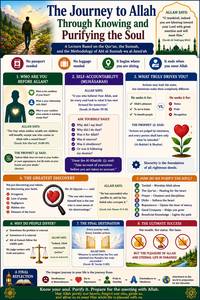
The Journey to Allah Through Knowing and Purifying the Soul
A Lecture Based on the Qur’an, the Sunnah, and the Methodology of Ahl al-Sunnah wa al-Jamā‘ah
All praise is due to Allah, the Lord of all worlds.
We praise Him, seek His help, seek His forgiveness, and seek refuge in Him from the evil within ourselves and from the consequences of our wrong actions.
Whomever Allah guides, none can misguide.
And whomever He leaves astray, none can guide.
I bear witness that there is no deity worthy of worship except Allah alone without partner, and I bear witness that Muhammad ﷺ is His servant and Messenger.
May the peace and blessings of Allah be upon him, his family, his Companions, and all who follow his guidance until the Day of Judgment.
⸻
Introduction
My dear brothers and sisters,
Human beings travel throughout their lives.
Some travel in search of wealth.
Others travel in pursuit of education.
Some travel seeking fame.
Others travel seeking leadership, influence, or success.
Many people cross oceans and continents.
Some spend decades pursuing worldly ambitions.
Yet there is one journey that is longer, deeper, and more important than all of them.
A journey that requires no passport.
A journey that requires no airplane.
A journey that requires no luggage.
A journey that begins where you are sitting right now.
It is the journey of knowing your soul, purifying it, and preparing it to meet Allah.
It is the journey of self-accountability.
It is the journey of sincere repentance.
It is the journey of faith.
It is the journey of returning to Allah before you are returned to Him.
Allah says:
“O mankind, indeed you are laboring toward your Lord with great exertion and will meet Him.”
(Surah Al-Inshiqaq 84:6)
Every human being is traveling.
The question is not whether you are traveling.
The question is:
Where are you heading?
And what will you meet at the end of your journey?
⸻
The Most Important Question: Who Are You Before Allah?
Many people know their names.
Their professions.
Their qualifications.
Their social status.
Their achievements.
But very few truly know who they are before Allah.
The real question is not:
What is your title?
What is your income?
How many followers do you have?
How many degrees have you earned?
The real question is:
What is the condition of your heart?
What is your relationship with Allah?
What is your condition when nobody is watching except Him?
Allah says:
“The Day when neither wealth nor children will benefit, except one who comes to Allah with a sound heart.”
(Surah Ash-Shu‘arā’ 26:88–89)
The greatest asset you possess is not your money.
It is not your position.
It is not your reputation.
It is your heart.
Because that is what Allah will examine.
The Prophet ﷺ said:
“Indeed Allah does not look at your bodies or your appearances, but He looks at your hearts and your deeds.”
(Muslim)
⸻
The Forgotten Practice: Self-Accountability
One of the greatest characteristics of the righteous predecessors was that they constantly evaluated themselves.
They feared their sins.
They questioned their intentions.
They examined their actions.
They did not spend their lives analyzing everyone else.
They analyzed themselves.
Allah says:
“O you who believe! Fear Allah, and let every soul look to what it has sent forward for tomorrow.”
(Surah Al-Hashr 59:18)
‘Umar ibn Al-Khattab رضي الله عنه said:
“Take account of yourselves before you are taken to account.”
The believer asks himself:
Why did I say that?
Why did I do that?
Was it for Allah?
Or was it for praise?
Was it sincere?
Or was it for reputation?
Was it obedience?
Or was it following my desires?
This type of self-examination is not weakness.
It is strength.
It is not pessimism.
It is wisdom.
It is the beginning of spiritual growth.
⸻
What Truly Drives You?
Many people know what they want.
Very few know why they want it.
Two people may seek the same position.
One seeks it to serve Islam and benefit people.
The other seeks it to satisfy pride.
Two people may seek knowledge.
One seeks Allah’s pleasure.
The other seeks status.
The action appears identical.
But the intention makes them completely different.
The Prophet ﷺ said:
“Actions are judged by intentions, and every person shall have only what he intended.”
(Al-Bukhari and Muslim)
This is why understanding your intentions is one of the most important responsibilities of a believer.
Ahl al-Sunnah teach that actions of the heart are among the greatest acts of worship.
Sincerity.
Love of Allah.
Fear of Allah.
Hope in Allah.
Reliance upon Allah.
These are the foundations upon which all righteous deeds stand.
⸻
The Greatest Discovery
The greatest discovery is not discovering your talents.
The greatest discovery is discovering your faults.
Discovering your arrogance.
Discovering your love of praise.
Discovering your negligence.
Discovering your hidden sins.
Discovering the diseases of the heart before they destroy you.
Ibn Al-Qayyim رحمه الله said:
“The one who knows himself best is the one who is most aware of his shortcomings.”
The righteous predecessors feared hypocrisy more than they feared many major sins.
Not because they were hypocrites.
But because they knew the danger of becoming satisfied with themselves.
The believer never feels safe from his shortcomings.
He continues striving until death.
⸻
Why Do People Differ?
People often blame circumstances for everything.
Islam teaches a more balanced view.
Sometimes the problem is external.
Sometimes it is internal.
Sometimes a person is oppressed.
Sometimes he oppresses himself.
Ahl al-Sunnah reject extremes.
We neither blame ourselves for everything nor blame others for everything.
We judge matters according to truth and justice.
Allah says:
“Indeed, Allah commands justice.”
(Surah An-Nahl 16:90)
The believer looks honestly at himself.
He admits mistakes.
He seeks forgiveness.
He corrects his course.
And he avoids the arrogance of always assuming he is right.
⸻
The Reality of the Nafs
One of the greatest realities taught by the Qur’an is that every human being has a soul that requires purification.
Allah says:
“He has succeeded who purifies it, and he has failed who corrupts it.”
(Surah Ash-Shams 91:9-10)
This is the true lifelong project of every Muslim.
Not merely self-discovery.
But self-purification.
Not merely self-awareness.
But self-reform.
Not merely understanding yourself.
But bringing yourself into obedience to Allah.
The objective is not to become comfortable with your weaknesses.
The objective is to overcome them through faith, repentance, and obedience.
⸻
How Do We Purify the Soul?
The Qur’an and Sunnah identify clear means of purification:
1. Tawḥīd
Knowing Allah.
Worshipping Him alone.
Directing all acts of worship exclusively to Him.
2. The Qur’an
Allah describes it as:
“A healing for what is in the hearts.”
(Surah Yunus 10:57)
3. Prayer
The five daily prayers cleanse sins and discipline the soul.
4. Dhikr
The remembrance of Allah softens hearts.
5. Repentance
No matter how many mistakes a person has made, the door of repentance remains open until death.
6. Good Company
Righteous companions help us see our faults and encourage us toward goodness.
7. Seeking Beneficial Knowledge
Knowledge illuminates the path to Allah and protects us from ignorance and misguidance.
⸻
The Final Destination
Every journey ends.
Every traveler eventually arrives.
Every human being will stand before Allah.
The greatest success is not worldly achievement.
The greatest success is arriving safely before Allah with faith.
Allah says:
“Whoever is saved from the Fire and admitted into Paradise has truly succeeded.”
(Surah Āl ‘Imrān 3:185)
This is the ultimate goal.
Not fame.
Not wealth.
Not status.
Not recognition.
But the pleasure of Allah and eternal life in Paradise.
⸻
Conclusion
My dear brothers and sisters,
The longest journey in your life is not a journey across countries.
It is not a journey toward wealth.
It is not a journey toward status.
It is the journey from heedlessness to remembrance.
From sin to repentance.
From pride to humility.
From disobedience to obedience.
From ignorance to guidance.
From attachment to this world to preparation for the Hereafter.
It is the journey of knowing your soul so that you may purify it.
The journey of purifying it so that you may meet Allah with a sound heart.
And perhaps the most important question every one of us should ask tonight is:
If I were to meet Allah today, am I truly prepared for that meeting?
May Allah purify our hearts, forgive our sins, guide us to the straight path, and allow us to meet Him while He is pleased with us.
And may the peace and blessings of Allah be upon our Prophet Muhammad ﷺ, his family, and his Companions.
Āmīn